
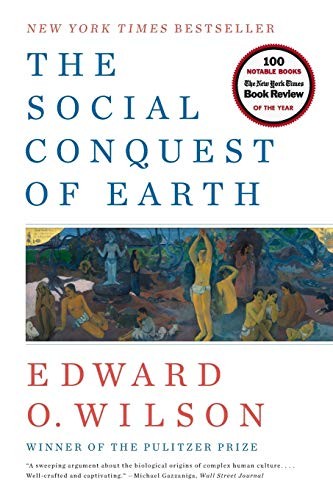
Wilson wants to answer three questions in this book, where did we come from, what are we, where are we going, and he’s ninety years old and one of the great living naturalists so I figure he’s earned the right to ask them without irony. The core argument is about eusociality, the rare evolutionary trick of a “nest,” a home base worth defending, that produced ants and termites and also, weirdly, us. He walks the kin-selection-versus-group-selection fight like someone who has actual skin in it, because he does, and even when I couldn’t fully track the technical stakes I could feel how much this argument matters to him.
Here’s my honest complaint and I don’t think I’m alone in it: there is a stretch in the middle, probably seventy-five pages, that is just ants. He’s the world’s expert on them, fine, but I felt the book sag exactly where everyone else who’s mentioned this to me felt it sag too. Skip nothing if you’re the type who reads front to back on principle, but know it’s coming.
What kept me reading through that stretch was the writing itself, which is genuinely better than it has any right to be for a book this dense with citation. There’s a passage near the front about Gilgamesh that has nothing to do with ants at all and everything to do with why we tell ourselves stories about death, and it’s the best few pages in the book. His closing chapter on humanity’s future in space felt narrower than the rest, like he ran out of the same rigor he brought everywhere else, but that’s a small ding on a book that otherwise reframed how I think about why people cooperate at all. Four stars, save one for the ants.